
Review · WALKING TOURS
Discover Valletta Half-Day Walking Tour
Valletta packs centuries into a small space. This $22.11 group walking tour gives you a useful first look at Malta’s capital, linking the City Gate, grand palaces, harbour viewpoints, and Fort St. Elmo in about three hours and 15 minutes. I like the easy-to-find start near the Triton Fountain, and I like that the tour leaves your afternoon open for museums, lunch, or the ferry to the Three Cities. The main drawback is the large group, which can reach 50 people, and one account describes a long wait while everyone assembled.
The tour works best as an introduction rather than a full study of Valletta. You get a licensed guide, a clear route, and time to decide which attractions deserve your admission money. Guide Josephine earned especially warm praise for making the history fun, while Maria was noted for her friendly and capable city tour. Still, the experience can vary if the guide has to explain in two languages or keeps the commentary too basic.
In This Review
- Key things to know before you book
- Starting beside the Triton Fountain at 9:15 a.m.
- Renzo Piano’s modern entrance to old Valletta
- Castille and the high point of Valletta
- Auberges, palaces, and the story of power
- Your 45 minutes at St. John’s Co-Cathedral
- St. George’s Square and the Grand Master’s Palace
- Reaching Fort St. Elmo and Malta’s wartime story
- What the $22.11 price really buys
- Guide quality and group size
- Who should choose this Valletta walk?
- Should you book the Discover Valletta Half-Day Walking Tour?
- FAQ
- Where does the Valletta walking tour start?
- What time does the tour begin?
- How long does the walking tour last?
- Where does the tour end?
- Is admission to St. John’s Co-Cathedral included?
- Is hotel pickup and drop-off provided?
- What is the cancellation policy?
Key things to know before you book
- The route crosses nearly all of Valletta: You begin at the City Gate and finish near Fort St. Elmo and the Malta Experience.
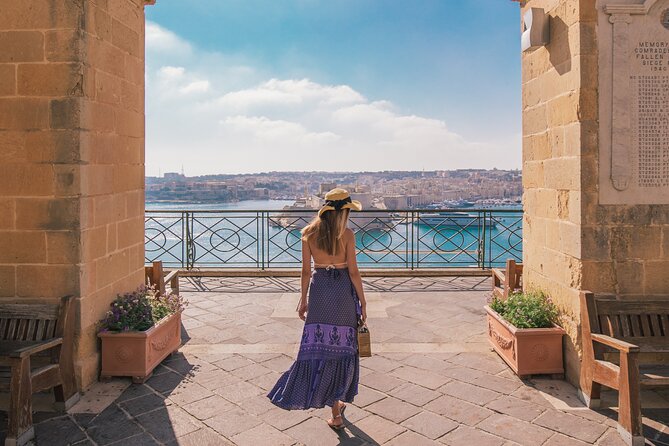
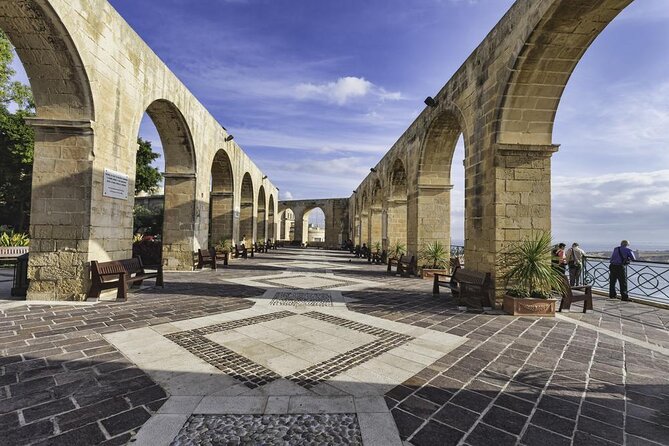
- Upper Barrakka Gardens is a highlight: The 15-minute stop gives you one of the best open views of the Grand Harbour and the Three Cities.
- St. John’s Co-Cathedral gets 45 minutes: Admission is not included, so you can choose between paying to enter, shopping, or taking a café break.
- The group may be large: The maximum is 50 people, so stay close to the guide and expect less personal attention than on a private walk.
- The tour ends at 12:45 p.m.: You can then pay for the 1 p.m. Malta Experience show or continue exploring independently.
- The price covers guidance, not attractions: The low fare is good value if you mainly want orientation and exterior visits.
Starting beside the Triton Fountain at 9:15 a.m.
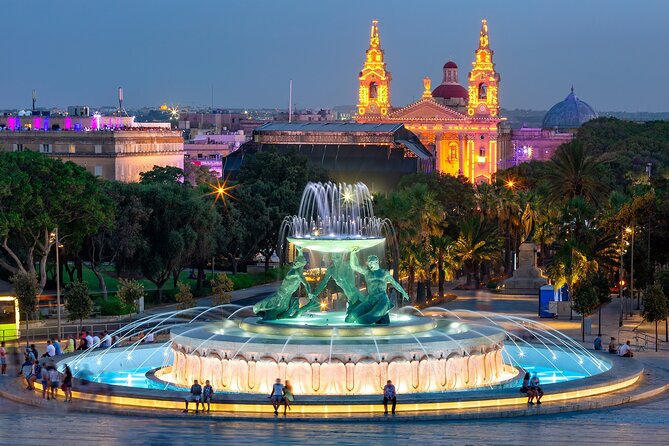
The meeting point is The Phoenicia Malta, beside The Mall in Floriana. The nearby Triton Fountain sits just outside Valletta’s City Gate, making it a practical landmark for finding the group. Three bronze Tritons hold up a broad basin, and the fountain, first opened in 1959 and restored in 2018, gives you a quick introduction to Malta’s mix of old stone and modern design.
The start point is easy to reach by public transport, and no hotel pickup or drop-off is provided. Plan to arrive early. One Italian-language account described waiting almost an hour for all participants to arrive, so a prompt group is not guaranteed. That may be an isolated delay, but it is a good reason not to schedule a tight morning flight, cruise departure, or prepaid attraction immediately afterward.
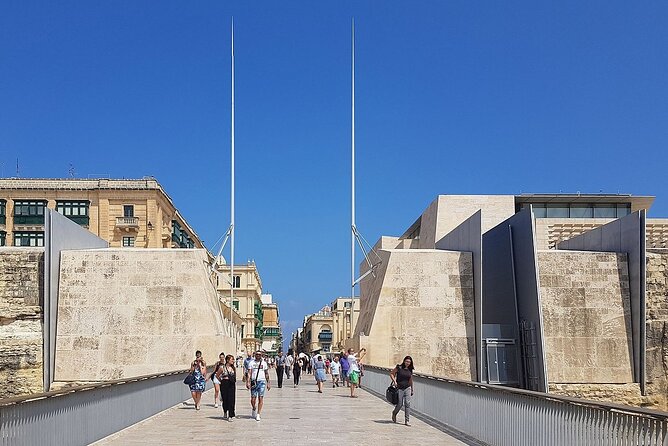
The walk begins with the City Gate, the fifth gate built on this site. The present version was designed by Italian architect Renzo Piano and completed in 2014. It cuts through the Porta Reale Curtain, the wall between St. James’ and St. John’s Bastions, and leads directly onto Republic Street.
More Walking Tours in Malta:
- The Original Valletta Walking Tour
★ 5.0 · 2,719 reviews - Valletta: 3-Hour Walking Tour
★ 4.7 · 1,605 reviews - Valletta: Guided City Walking Tour
★ 4.8 · 1,256 reviews
Renzo Piano’s modern entrance to old Valletta
The City Gate Project gives the beginning of the walk a clear visual contrast. The gate is stark and modern, while the streets beyond it were laid out by the Order of St. John in the 16th century. That contrast helps explain why Valletta can feel both ancient and contemporary within the same block.
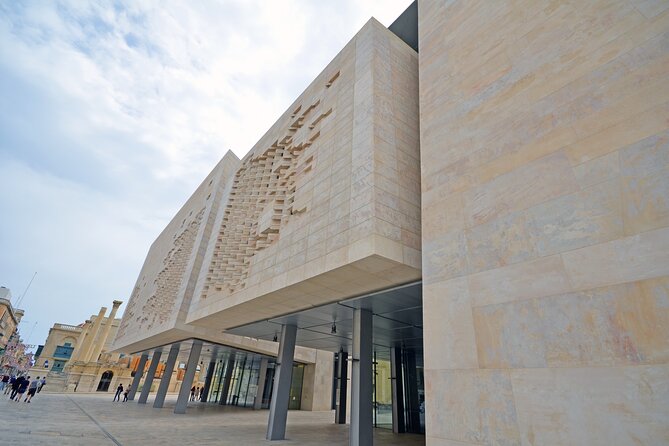
You then pass the New Parliament, another Renzo Piano project completed between 2011 and 2015. Its two stone-clad blocks are linked by bridges, and the Gozitan limestone facing is meant to suggest honeycombs. The name Malta is connected with Melite, meaning honey, so the design carries a local reference rather than being modern decoration for its own sake.
Next comes the Royal Opera House site. The original building opened in 1866, then suffered a direct bombing hit in 1942. Instead of rebuilding it as a closed replica, Piano’s redesign kept the ruins and turned the site back into a performance venue in 2013. You spend only about five minutes at each of these early stops, so expect a quick explanation and an exterior view, not a full architectural talk.
Castille and the high point of Valletta
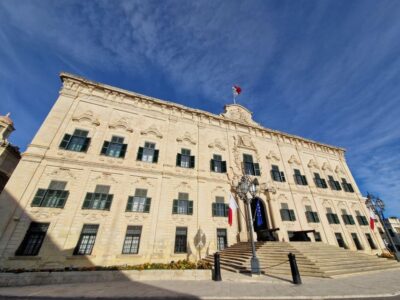
Auberge de Castille sits near the highest point of Valletta. Built in the Baroque style in the 1740s under Grand Master Manuel Pinto da Fonseca, it replaced an earlier house for knights from the langues of Castile, León, and Portugal. The building is now the Office of the Prime Minister of Malta, so you view an active government building rather than a standard museum stop.
The short pause is enough to appreciate its heavy stone front and formal scale. If grand Baroque architecture interests you, you may want to return later for a slower look. Admission is not included, and the walking tour does not allow time for a full interior visit here.
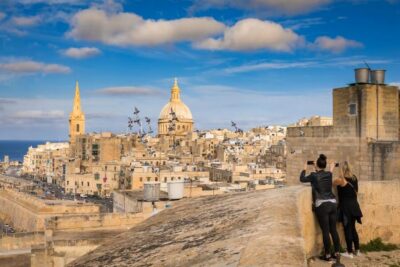
The nearby Upper Barrakka Gardens is the first stop where the schedule gives you room to breathe. You have about 15 minutes to look across the Grand Harbour, the Three Cities, the shipyard, and the lower parts of Valletta. The gardens occupy the upper level of St. Peter and Paul Bastion, built in the 1560s, and were originally a recreation area for knights of the Italian langue.
This is one of the tour’s best uses of time. The view gives you a sense of Malta’s defensive setting, something that is harder to grasp from narrow streets and stone façades. I would use the stop for photographs, but also listen carefully to the guide’s explanation of the harbour and fortifications.
Auberges, palaces, and the story of power
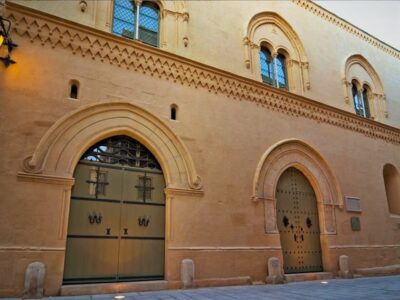
The route continues to Auberge d’Italie, built in the late 16th century for Italian knights of the Order of St. John. Since 2018, it has housed MUŻA, Malta’s National Art Museum. The tour allows about five minutes, so you can note the building and decide if the museum merits a separate visit.
Palazzo Parisio adds a more unusual historical detail. Built in the 1740s, it later passed through the Muscati and Parisio Muscati families. Napoleon stayed here for six days in June 1798, during the early French occupation of Malta. The government later used the building as the General Post Office and then for the Ministry for Agriculture. It now houses the Ministry for Foreign Affairs.
These quick stops are useful for seeing how Valletta’s buildings changed function over time. Knights’ residences became museums, government offices, and public institutions. The limitation is pace. You will hear the basic story, but you will not have time to inspect interiors or linger over architectural details.
A completely different kind of day:
- Malta: Gozo & Comino Islands, Blue Lagoon & Seacaves Tour
★ 4.5 · 15,672 reviews - Comino: Blue Lagoon, Crystal Lagoon, and Seacaves Tour
★ 4.6 · 5,673 reviews - Malta: Blue Lagoon, Beaches & Bays Trip by Catamaran
★ 4.7 · 5,496 reviews - Malta: Gozo, Comino, Blue & Crystal Lagoon, & Caves Cruise
★ 4.6 · 5,092 reviews
Your 45 minutes at St. John’s Co-Cathedral
St. John’s Co-Cathedral is the most important decision point on the walk. You get 45 minutes in the area, but the entrance fee is separate. You can buy a ticket to see the cathedral and museum, including Caravaggio paintings in the Oratory, Flemish tapestries, and the church museum. Admission includes a multilingual audio guide.
The interior is known for an elaborate marble-inlaid floor, one of the great decorative floors in Europe. If you care about art and church interiors, this is the place where spending extra money can turn a quick orientation tour into a much stronger morning. Forty-five minutes is enough for a focused visit, but not for a slow reading of every chapel and object.
You are not required to enter. The free time also works for Republic Street shopping, a rest in Republic Square, or a drink at one of the nearby cafés. This flexibility is valuable because the group may include people with different interests. It also means the guide is not controlling every minute of your day.
Pay attention to the agreed meeting place and time. The group reunites after the 45-minute break for the final section. If you wander too far or lose track of the meeting point, the rest of the walk becomes awkward.
St. George’s Square and the Grand Master’s Palace
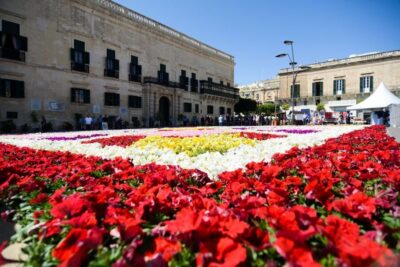
St. George’s Square, also called Palace Square, is Valletta’s largest central square. It faces the Grand Master’s Palace, the city’s largest palace and one of its main symbols of government.
The square has changed over the centuries, but it has remained a setting for public ceremonies and major occasions. The guide’s short stop helps connect the open space with the political life of the city. You will have only around five minutes, so treat this as a scene-setting pause rather than a formal square tour.
The Grand Master’s Palace was built in stages from the 16th through the 18th centuries. It served as the residence of the Order of St. John’s Grand Masters, later housed Malta’s Parliament until 2015, and now contains the Office of the President. The State Rooms and Palace Armoury are open as a museum, but admission is not part of this tour.
This is another place where the low tour price has a trade-off. You get the outside context and can return later if the interior interests you. You do not pay for sights you may not want to visit, but you also need to budget separately for the attractions that appeal to you.
Reaching Fort St. Elmo and Malta’s wartime story
The final section heads toward Fort St. Elmo, at the tip of the Sciberras Peninsula. The star fort guards the entrances to both Grand Harbour and Marsamxett Harbour, along with Fort Tigné and Fort Ricasoli. Its most famous chapter came during the Great Siege of Malta in 1565.
Part of the fort now houses the National War Museum. The tour gives you a short exterior introduction, not a full museum visit. If military history is a priority, note the location so you can return with more time. The fort helps explain why Valletta was built where it was, and why the harbour views from the city walls matter so much.
The walking tour ends at the entrance to the Malta Experience at 12:45 p.m. The venue offers a 45-minute multilingual audio-visual presentation on Malta’s history. The 1 p.m. show is not included, but the timing makes it a convenient optional add-on. You can also have a drink or snack while looking over the Grand Harbour before making your own way onward.
This ending is practical. You are not returned to the starting point, so you can continue near the tip of Valletta rather than retracing the route. If you need to get back to a hotel or port, allow time for your own transport.
What the $22.11 price really buys
At $22.11 per person, this is an inexpensive way to get a route through Valletta and a basic explanation of its major buildings. A private guide would cost more, while exploring alone would require you to plan the route and research each stop yourself. The group format keeps the fare down and covers a surprising amount of ground.
The price does not include admission to St. John’s Co-Cathedral, the New Parliament, Royal Opera House site, Auberge de Castille, Auberge d’Italie, Palazzo Parisio, the Grand Master’s Palace, Fort St. Elmo, or the Malta Experience. Some of these are viewed from outside, while St. John’s receives dedicated free time for an optional visit.
That arrangement suits you if you want control over spending. It is less suitable if you expect one ticket to cover the city’s main museums and monuments. Bring a little flexibility to your budget, especially if Caravaggio, the cathedral floor, or the Malta Experience is high on your list.
Guide quality and group size
The tour includes a licensed guide in English, French, German, Italian, or Spanish, according to the language booked. Josephine was praised for making the half-day enjoyable, and Maria was singled out for her friendly manner and ability to lead an interesting visit.
Language setup matters here. The operator indicates that tours normally run in one language, but they can sometimes be conducted in two. One Spanish-language experience was criticized for basic information and limited explanation, with the provider noting that bilingual tours can occasionally happen. If detailed history is your main goal, confirm the language arrangement when booking and keep your expectations realistic.
A maximum of 50 people is a lot for a walking tour. You may hear the main points clearly in an open square, but narrow streets and busy public areas can make it harder to stay close. The tour’s value comes from orientation and coverage, not intimate conversation with the guide.
Most people can participate, and service animals are allowed. The experience is near public transportation, but no hotel transfer is included. Wear comfortable shoes and expect a steady city walk with stops, waiting, and time on stone streets.
Who should choose this Valletta walk?
I would recommend it to a first-time visitor who wants a quick framework for Valletta. It is also useful if you have only one morning, want to keep costs low, or prefer to decide for yourself which paid attractions deserve more time.
It suits independent visitors because the St. John’s break gives you choices. You can enter the cathedral, shop, sit at a café, or simply rest before the final section. The end near the Malta Experience also makes it easy to add another activity.
I would be more cautious if you want a specialist architectural tour, a small group, or a detailed account of Maltese history. The five-minute stops move quickly, and the group can be large. A guide who has to work in two languages may leave you with an even shorter explanation.
The overall rating is 3.8 from four published ratings, which fits the experience as described: several strong impressions, one serious complaint about shallow commentary, and one warning about a slow start. Guide personality appears to make a real difference.
Should you book the Discover Valletta Half-Day Walking Tour?
Book it if you want an affordable morning orientation, strong harbour views, and a well-planned path through Valletta’s main sights. The Upper Barrakka Gardens, the 45-minute St. John’s option, and the finish at the Malta Experience give the tour more flexibility than a simple point-to-point walk.
Skip it if your priority is deep historical detail or a quiet, personal guide. In that case, use the route as a self-guided plan and spend your money on St. John’s Co-Cathedral, Fort St. Elmo, or the Malta Experience instead.
For most first visits, the $22.11 fare is fair value. Arrive early, confirm the tour language, keep your afternoon flexible, and treat the walk as a smart introduction rather than the final word on Valletta.
FAQ
Where does the Valletta walking tour start?
It starts at The Phoenicia Malta, The Mall, Floriana, Malta, near the Triton Fountain and Valletta City Gate.
What time does the tour begin?
The scheduled start time is 9:15 a.m.
How long does the walking tour last?
The tour lasts approximately three hours and 15 minutes. It ends at 12:45 p.m. at the Malta Experience.
Where does the tour end?
The tour ends at The Malta Experience, St. Elmo Bastions, Triq Il-Mediterran, Valletta.
Is admission to St. John’s Co-Cathedral included?
No. You receive 45 minutes of free time near St. John’s Co-Cathedral, but entrance to the cathedral and museum is an additional cost.
Is hotel pickup and drop-off provided?
No. Hotel pickup and drop-off transport are not included.
What is the cancellation policy?
You can cancel up to 24 hours before the local start time for a full refund. Cancellations or changes made less than 24 hours before the start are not refunded or accepted.
Just added in Malta
- Wakeboarding Adventure in Malta: Learn to Ride★ 5.0 · 4 reviews
- Gozo: Wine Tasting and Paired Dinner Experience★ 4.9 · 43 reviews
- Victoria, Gozo: Sunset Walking Food and Drink Tour★ 5.0 · 6 reviews
- World War II Malta Full-Day Walking Tour★ 4.3 · 18 reviews
- Malta: 5 hr Vintage Bus Tour – Mdina & Blue Grotto inc. food★ 5.0 · 22 reviews
- Valletta: Private Massage from a world renowned masseuse★ 4.6 · 9 reviews
- Valletta Street Food & History Tour With Private Transfers★ 4.5 · 15 reviews
- Valletta: Private Walking Tour With A Guide ( Private Tour )★ 5.0 · 1 review
Walking Tours, compared.

Guided Walking Tour with Optional Cathedral Tour
Read our review →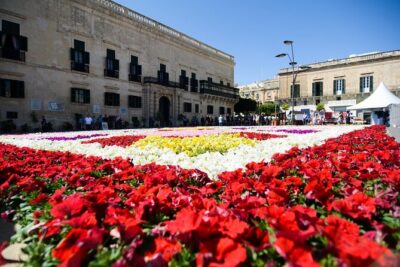
The Valletta Street Food and Culture Walking Tour
Read our review →Browse the lists this tour appears in